

What is a kavach? The Sanskrit word for armor, and the Narasimha kavacha
Kavach, or kavacha, means armor in Sanskrit. What the word means, the kavacha as a prayer and as an amulet, the story of Narasimha, and how our amulets grew from this tradition.
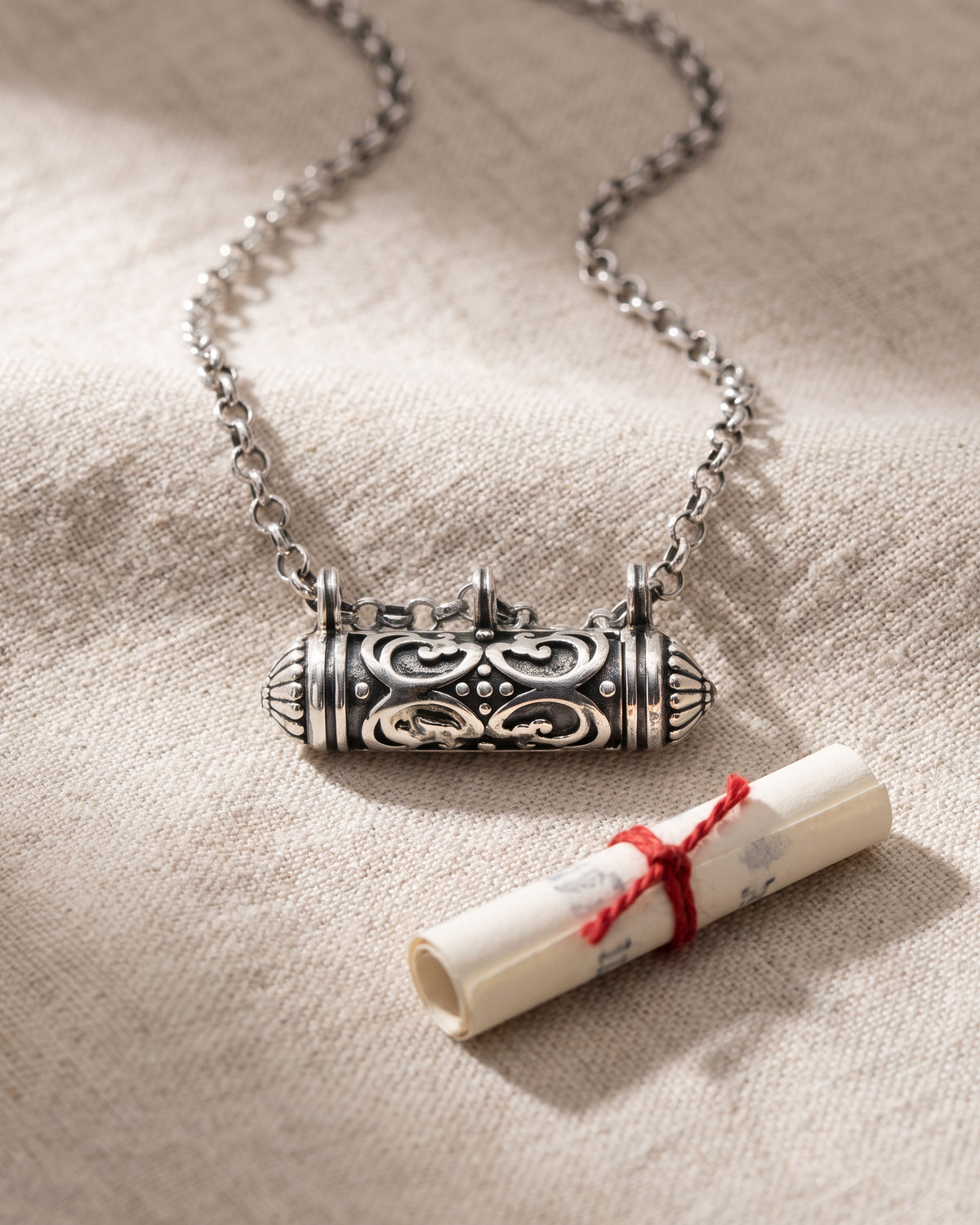
Kavacha means armor in Sanskrit. In Hindi the final vowel falls away, so you will also hear and see it as kavach. The word names three related things: armor worn in battle, a prayer recited for divine protection, and a small amulet worn on the body. This guide explains each, tells the story of the Narasimha kavacha, and shows how the amulets of Kavacha Designs | Sacred Armor™ grew from this tradition.
The word: armor, a covering, an amulet
The standard Sanskrit dictionary, Monier-Williams, gives kavaca first as "armour, cuirass, a coat of mail", and more widely as "any covering". The same entry gives a second meaning: "a piece of bark or birch-leaf or any substance inscribed with mystical words and carried about as an amulet". It can also mean a sacred syllable in a mantra that is used as an amulet.
Kavacha is pronounced kuh-VAH-chuh. Kavach is the same word in its Hindi form: in Hindi, the short "a" at the end of a written word is usually not spoken.
The armor sense is old. In the Mahabharata, the warrior Karna is born with a natural coat of mail and a pair of earrings, and in one of the epic's best-known scenes he peels the armor from his own body and gives it away.
A kavacha as a prayer
If you searched for a kavach and found a prayer, that is because in Hindu devotional traditions a kavacha is also a hymn. A kavacha prayer asks the Divine to guard the one who recites it, often part by part, like armor made of words. As the Sacred Tradition page on our site puts it, "a kavacha does not always refer to a piece of jewelry. Sometimes the armor is the prayer itself."
- The Narayana kavacha is taught in the Srimad Bhagavatam, in the eighth chapter of the sixth canto, titled "The Narayana-kavaca Shield". It describes a shield made of the mantra of Vishnu.
- The Devi kavacham is recited with the Devi Mahatmya. Verse by verse, it asks a named goddess to abide in each part of the body.
- The Narasimha kavacha is traditionally attributed to the Brahmanda Purana, and is said to have been first spoken by Prahlada, the young devotee at the heart of Narasimha's story.
We don't reproduce these prayers here. If you want to recite one, a temple, a teacher or your family's tradition is the right guide, and texts and translations are published by the traditions themselves, such as the Bhagavatam at vedabase.io.

The story of Narasimha
Narasimha is one of the ten avatars, or incarnations, of Vishnu. Britannica tells the story briefly: the demon Hiranyakashipu won a boon from Brahma that he could not be killed by human or animal, inside or outside, by day or by night. His son, Prahlada, was a devotee of Vishnu, even though his father threatened his life for it. When the demon kicked a stone pillar and asked whether Prahlada's god was in it too, Vishnu emerged from the pillar as a man-lion and slew him at dusk, on the threshold. The Srimad Bhagavatam tells the same story at length in its seventh canto.
A Narasimha kavacha can be a prayer or an amulet. Our Sacred Tradition page describes one living example of the amulet: in Mayapur, Narasimha amulets are described as containing the deity's mantra and are offered to Lord Narasimhadeva before they are worn.
A kavach as an amulet
The physical kavach follows the dictionary's second meaning. In Jayashri's words: "Traditionally, a kavacha is an amulet carried for spiritual protection. It could contain sacred words written on bark, birch leaf, or another material and worn close to the body." Some hold a mantra; some hold a yantra, a sacred diagram. The Victoria and Albert Museum holds a 20th-century silver amulet case from India with hinged sides so it could be worn on the upper arm.
In some Hindu traditions an amulet is prepared through puja: a priest or another qualified practitioner, according to the lineage, offers it before the deity and recites mantras, and some traditions include a rite of consecration called prana pratishtha. There is no single set of rules shared by every tradition, and the priest or teacher who prepares an amulet may give their own guidance. Our Sacred Tradition page describes these practices in more detail.
Not the train system
If your search also turned up railways: Kavach is the name of Indian Railways' automatic train protection system, named after the Hindi word for shield. It is unrelated to the amulet or the prayer.
Kavacha, the amulets
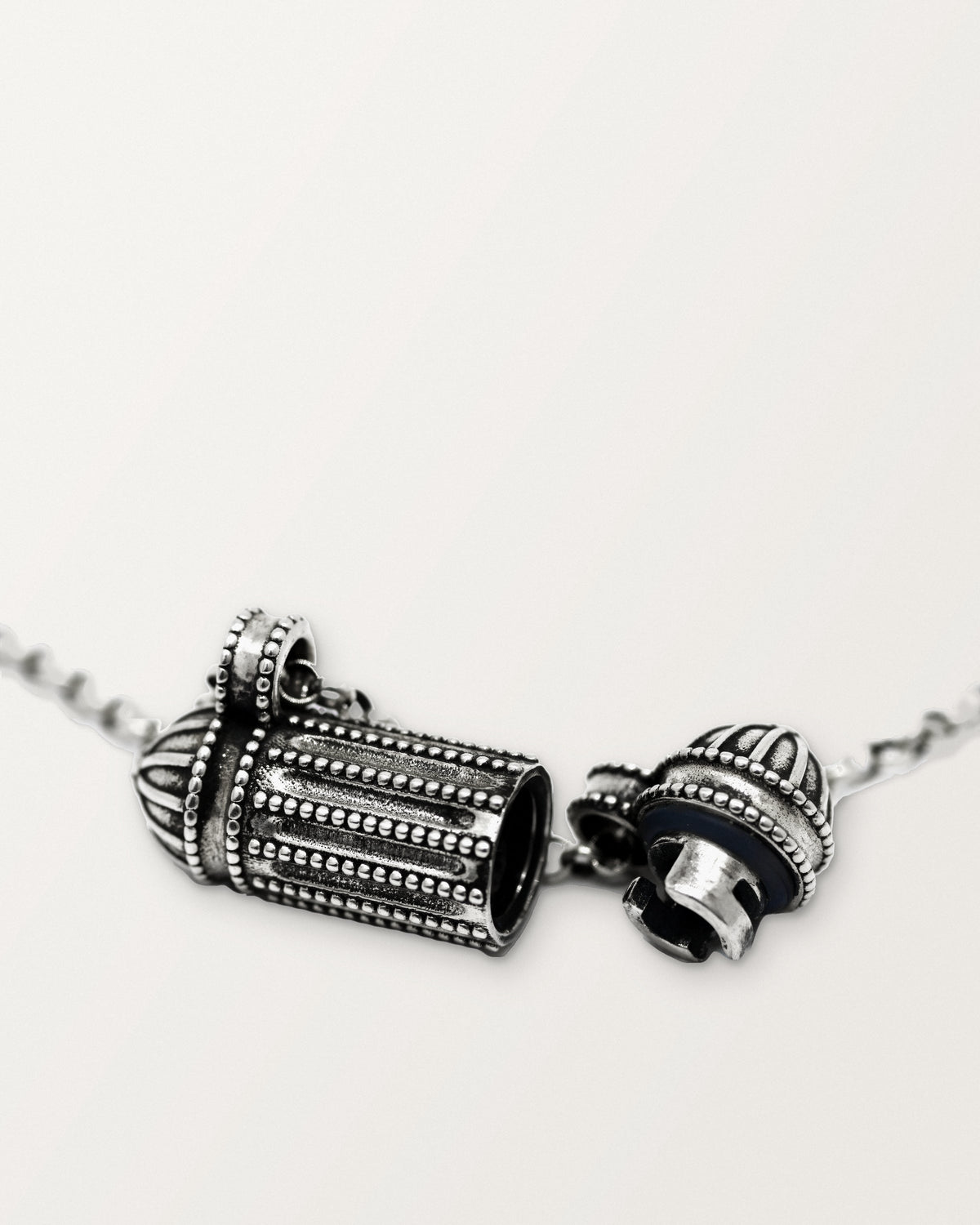
Kavacha is rooted in the Hindu tradition of kavacha and in Jayashri Triolo's more than forty years of Bhakti yoga, in the Gaudiya Vaishnava tradition. She founded Kavacha in 2018. The name comes from that practice, and every piece she designs opens to a private chamber, a place for a prayer, a mantra, a vow or a trace of someone loved.
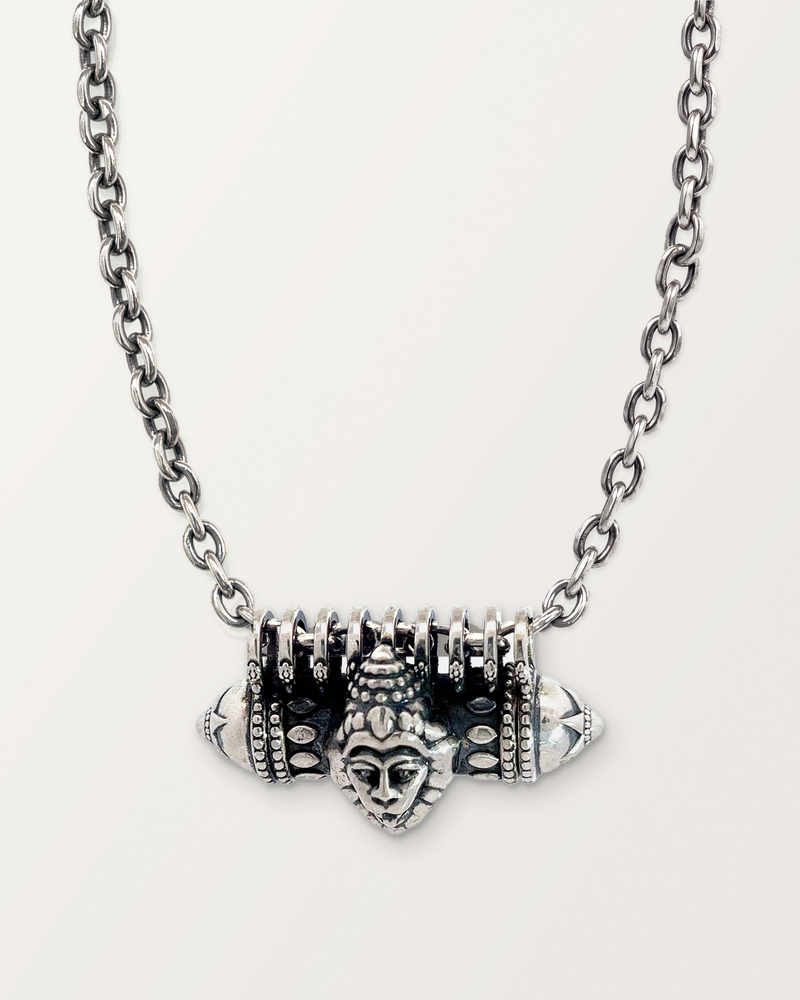
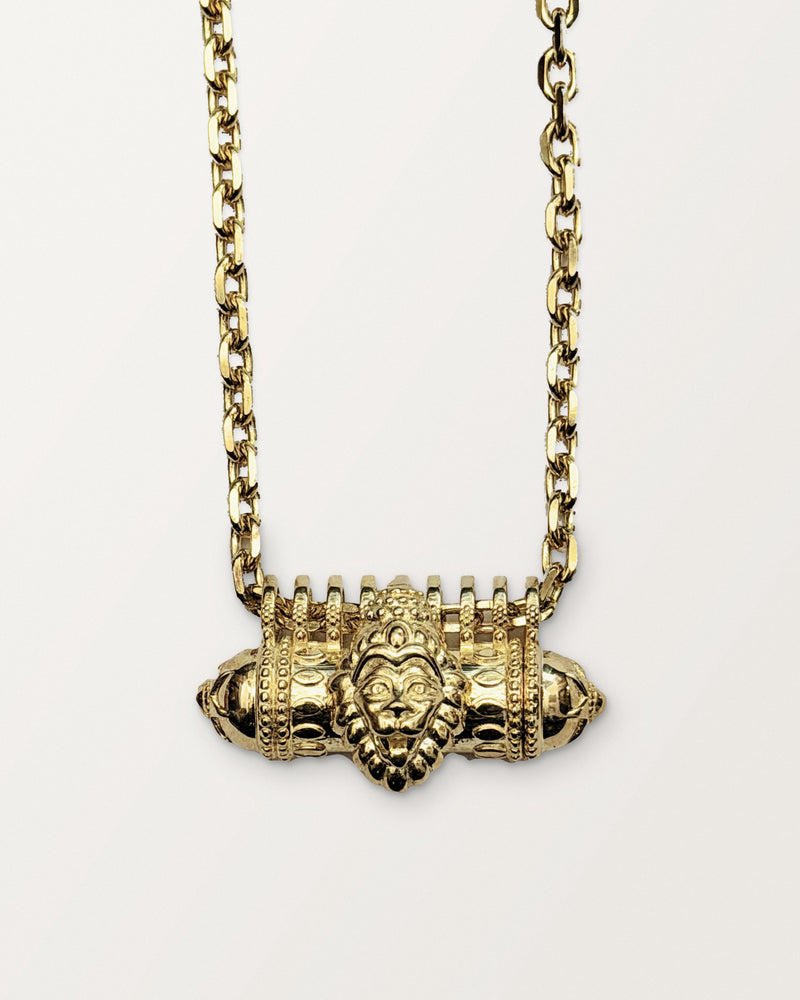
Narashimha is the cornerstone of the collection and the first piece Jayashri ever made. Before she began, she sought the blessings of her spiritual teacher to design and create Kavachas. It measures about 38 × 17 mm. The pendant weighs about 15.2 g in sterling silver, ready to ship within 2 business days, or it is made to order in 14K or 18K yellow gold, which takes 4 to 6 weeks. Measured from its design files, the chamber holds about 1.4 ml, room for a loosely rolled strip of paper about 28 mm wide and 160 mm long. A real fill is somewhat less, so the cap still closes.
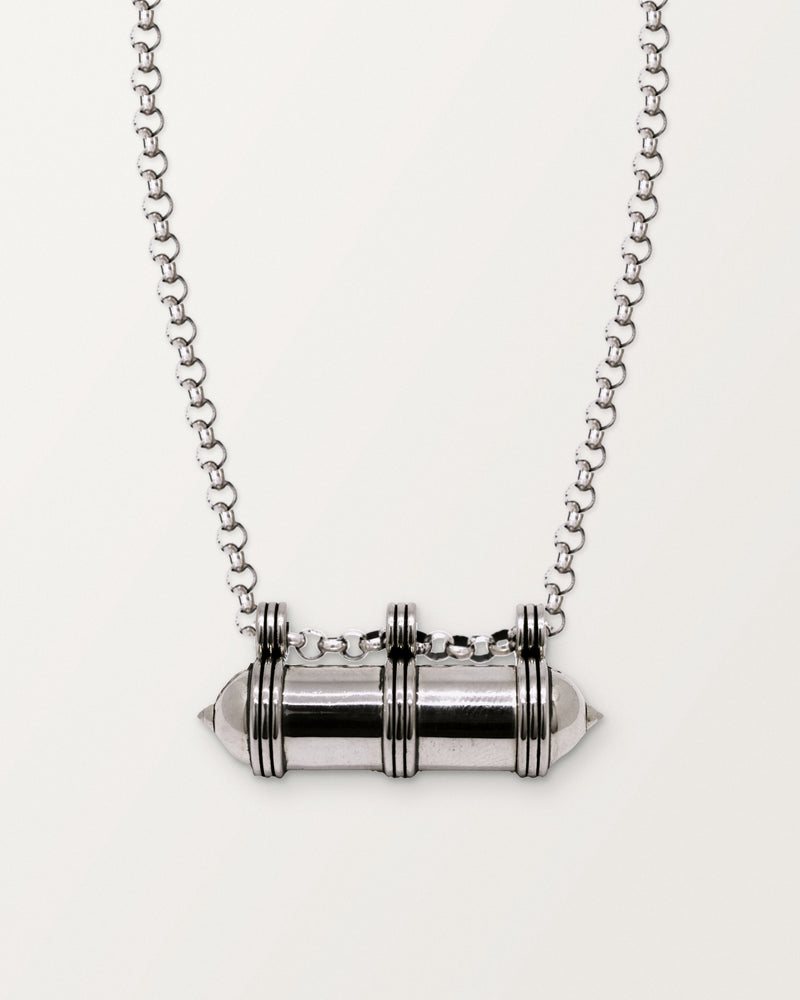
Antique Pave is Jayashri's original design, pared back. She took away the lion of Narashimha Dev so the detail of the body could speak on its own.
Other designs draw on the same devotional world. Vana is named for the forest of Vrindavan, where Krishna and the Gopis dance and sing their prayers. Pankaj is a classic Vedic amulet form. Sri takes its name from the Sanskrit shri.
A Kavacha comes to you empty. It is made in the form of a traditional amulet, and what it holds and means is yours: we don't promise protection or any spiritual outcome. If your tradition prepares or consecrates an amulet, your priest or teacher can guide you, and a written mantra fits inside. For a related amulet from the Islamic world, read What is a taweez?, and for more on our pieces, What is a Kavacha?
Questions people ask
What does kavach mean?
Kavach, or kavacha, means armor in Sanskrit. It also names a protective prayer and a small amulet worn on the body, often holding sacred words.
What is the Narasimha kavacha?
A hymn to Narasimha, the man-lion avatar of Vishnu, traditionally attributed to the Brahmanda Purana and said to have been first spoken by Prahlada. The name is also used for amulets dedicated to Narasimha.
Is a kavach a prayer or a pendant?
Both. In Hindu devotional traditions a kavacha can be a prayer recited for protection, or a physical amulet that holds a mantra or yantra. Sometimes the armor is the prayer itself.
How do you pronounce kavacha?
Kuh-VAH-chuh. In Hindi it is usually said and written kavach, without the final vowel.
Does a Kavacha come with a mantra inside?
No. Every Kavacha comes empty, so you can place your own prayer, mantra or keepsake inside. If consecration matters in your tradition, ask your priest or teacher.
Sources
- Monier-Williams, Sanskrit-English Dictionary, "kavaca", p. 264 (Cologne Digital Sanskrit Dictionaries).
- Srimad Bhagavatam 6.8, The Narayana-kavaca Shield and 7.8 (vedabase.io).
- Britannica, "Narasimha".
- Devi Mahatmya, "Devyah Kavacam".
- Sri Nrisimha Kavacha, as published by the ISKCON Alachua temple.
- The Mahabharata, Vana Parva, section 308 (K. M. Ganguli translation).
- Victoria and Albert Museum, amulet case, O1138177 and yantra amulet, O472397.
- Narasimhan, Sproat and Kiraz, "Schwa-deletion in Hindi text-to-speech synthesis", 2004.
- Press Information Bureau, Government of India, Kavach, 10 December 2024.
More guides: What is a taweez?, What you can keep inside an openable necklace, 14K, 18K or sterling silver and Keeping a loved one's ashes close. Or browse the whole collection.